HISA 167: Environmental Histories of the Americas
This course studies how workers, Indigenous communities, and urban social movements have organized in the context of past environmental changes. We will focus on a few places in the Americas, including Northeastern Brazil, Navajo Nation, and New York City. We will track the development of capitalism in these areas and both the slow-moving and sweeping environmental changes it produced. Then, we will learn about communities organizing amidst this turmoil: How did they resist exploitation? What sort of contradictions did they face? Through the story of these people, we will enter a world of economic structures and power relations. We will also see the workings of race and gender at play. Some of the questions we will address are: How did the production of commodities and energy transform environments across the Americas? What was the role of racial relations in shaping these developments? How did the legacies of environmental exploitation accumulate over time and how did these legacies affect the experience of people? This course will give you conceptual tools to understand environmental issues and activism today.
Uranium Mining in Navajo Nation?
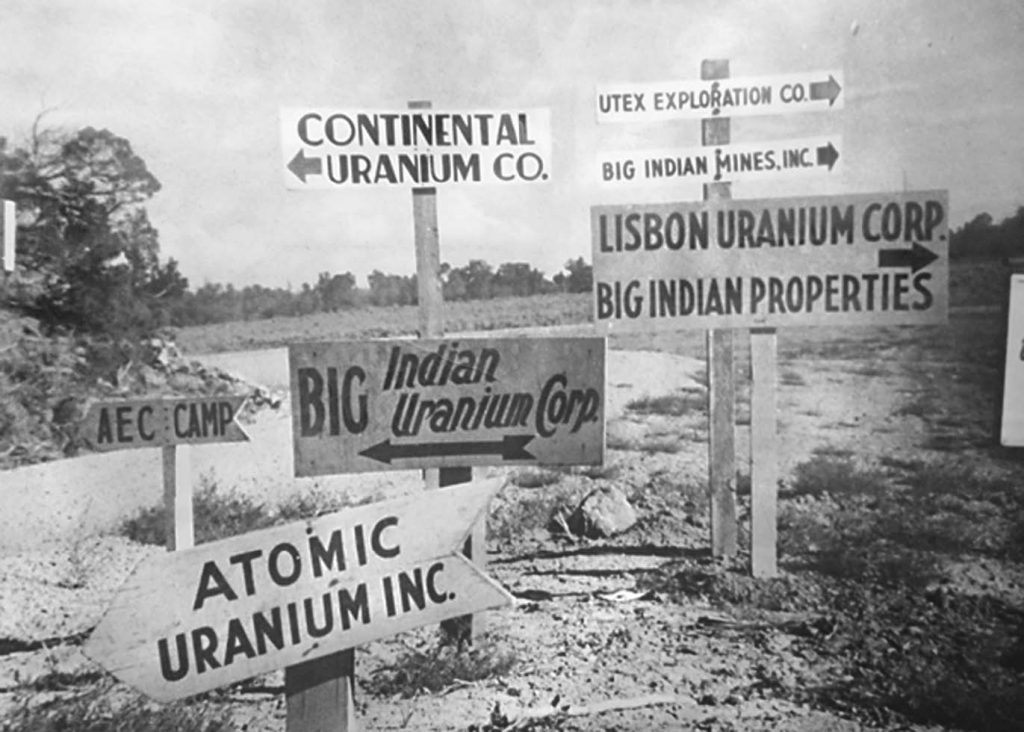
In the twentieth century, large portions of Navajo territory were mined for uranium. The legacies of radiation and water contamination are still felt today. Our class will investigate how this process was closely tied to histories of settler colonialism and U.S. imperialism.
Rubber production in the Amazon?
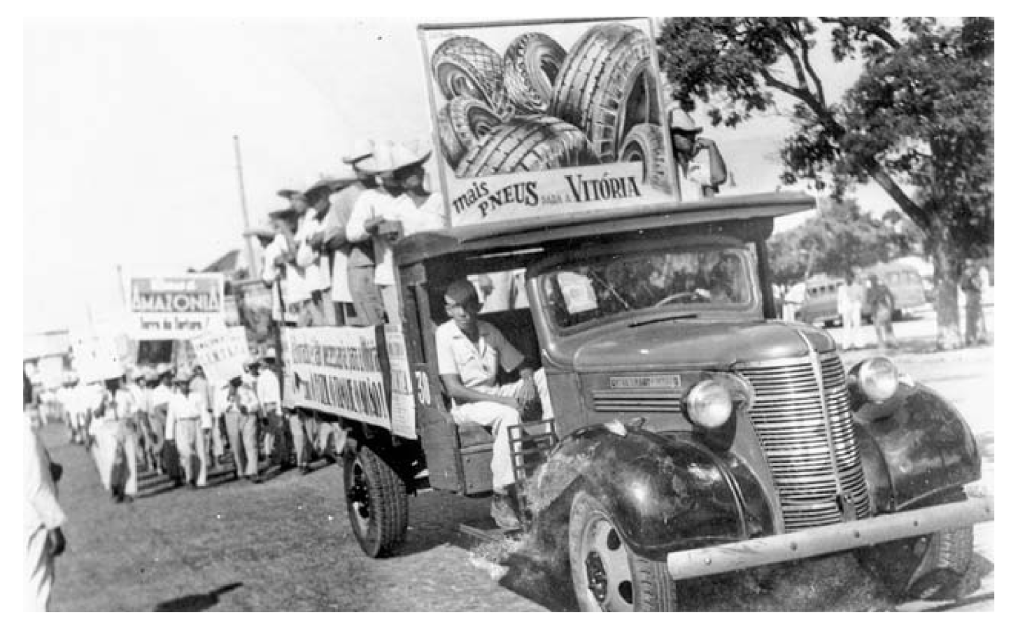
We know about deforestation in the Amazon due to cattle ranching today. Yet, this region has a fascinating social history. During the Second World War, for instance, the governments of Brazil and the US encouraged the extraction of natural rubber from trees. They did so by arguing that tapping rubber was a patriotic duty (“rubber for victory” some ads said) and that workers were “rubber soldiers.”
All Topics and Readings
REQUIRED TEXTS: All readings will be available online (either on canvas or through online library access)
Unit 1
Introduction: Racial Capitalism and the Environment
Week 1
- Ramtin Arablouei et al., “There Are No Utopias,” Throughline, NPR, February 24, 2022, https://www.npr.org/2022/02/20/1082030426/there-are-no-utopias. (podcast)
Unit 2
Sugar Plantations and the Brazilian Rainforest
Week 2
- Rogers, Thomas D. “An Eternal Verdure: The Long Duree of the Zona Mata.” In The Deepest Wounds: A Labor and Environmental History of Sugar in Northeast Brazil. University of North Carolina Press, 2010. https://ebookcentral.proquest.com/lib/ucr/detail.action?pq-origsite=primo&docID=605932
- Davis, Mike. “Brazil: Race and Capital in the Nordeste,” in Late Victorian Holocausts: El Niño Famines and the Making of the Third World (2002), http://hdl.handle.net/2027/heb.30886.
Week 3
- Rogers, Thomas D. “Landscapes of Captivity: Power and the Definition of Work and Space.” In The Deepest Wounds: A Labor and Environmental History of Sugar in Northeast Brazil. University of North Carolina Press, 2010. https://ebookcentral.proquest.com/lib/ucr/detail.action?docID=605932&pq-origsite=primo
- Garfield, Seth. “Rubber’s ‘Soldiers’: Reinventing the Amazonian Worker.” In In Search of the Amazon: Brazil, the United States, and the Nature of a Region. Duke University Press, 2013. https://www.degruyterbrill.com/document/doi/10.1515/9781478091325/html?_llca=transfer%3Af52357c9bb8e26bd4da980d1fe70df8e&_llch=1754656df053117c831b4a9982f363ecca0ffbe8366fe8142b651e51672fc43c
Unit 3
Energy Production in Navajo Nation
Week 4
- Review of Unit 2 (Come prepared)
- Powell, Dana E. “Extractive Legacies.” In Landscapes of Power. Politics of Energy in the Navajo Nation. Duke University Press, 2018. (pp. 45 – onward) http://www.jstor.org/stable/j.ctv1220jnq.7.
- Voyles, Traci Brynne. “Preface: In Search for Treasure.” In Wastelanding. Legacies of Uranium Mining in Navajo Country. University of Minnesota Press, 2015. https://www.jstor.org/stable/10.5749/j.ctt155jmrg.3.
- Voyles, Traci Brynne. “Introduction: Sacrificial Land.” In Wastelanding. Legacies of Uranium Mining in Navajo Country. University of Minnesota Press, 2015. http://www.jstor.org/stable/10.5749/j.ctt155jmrg.4.
Week 5
- Needham, Todd Andrew. “Introduction: Beyond the Crabgrass Frontier.” In Power Lines: Phoenix and the Making of the Modern Southwest. Princeton University Press, 2014. https://ebookcentral.proquest.com/lib/ucr/detail.action?docID=1726077
- Needham, Todd Andrew. “A Piece of Action.” In Power Lines: Phoenix and the Making of the Modern Southwest. Princeton University Press, 2014. https://ebookcentral.proquest.com/lib/ucr/detail.action?docID=1726077
Week 6
- Review of Unit 3 (come prepared)
- Midterm Exam
Unit 4
Lead Contamination in New York City
Week 7
- Rubio, Juan Manuel. “Air, Metal, and Earth.” Episodes 1, 2. 2021. http://historianrubio.com/airmetalandearth/. (podcast)
- Markowitz, Gerald, and David Rosner. “‘Cater to the Children’: The Role of the Lead Industry in a Public Health Tragedy, 1900-1955.” American Journal of Public Health 90, no. 1 (2000): 36–46. https://doi.org/10.2105/ajph.90.1.36.
Week 8
- Rubio, Juan Manuel. “Air, Metal, and Earth.” Episodes 4, 5. 2021. http://historianrubio.com/airmetalandearth/. (podcast)
- Housing Segregation and Redlining in America: A Short History | NPR. 2013. 6:36. https://www.youtube.com/watch?v=O5FBJyqfoLM&t=88s&ab_channel=NPR. (short video)
- Nielsen, Carrie. “Where the Lead Came From.” In Unleaded: How Changing Our Gasoline Changed Everything. Rutgers University Press, 2021. https://ebookcentral.proquest.com/lib/ucr/detail.action?pq-origsite=primo&docID=6690020
- “Diseases of Poverty.” In The Young Lords: A Radical History. The University of North Carolina Press, 2020. https://muse.jhu.edu/pub/12/monograph/book/72262.
Week 9
- Review of Unit 4 (Come prepared)
- Final discussion
Week 10
- Final Exam
